Happiness Is . . .
A new Vermont nonprofit wants to replace GDP with GNH
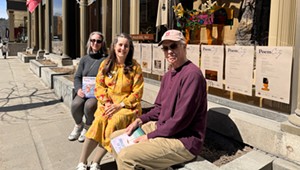
Linda Wheatley can list many reasons why gross domestic product is an inadequate measure of economic progress, but instead she offers this simple illustration:
“You could tear up that road outside, repave it, tear it up again and repave it again, and that would contribute to GDP,” Wheatley says during an interview at a Burlington coffee shop. “But it wouldn’t do anything for measuring ‘progress.’”
Seated beside her, Chris Wood notes a few more shortcomings of GDP as an indicator.
“Hurricanes, wars — it all contributes to GDP,” he says. “GDP doesn’t measure damage to the environment, doesn’t measure volunteerism, doesn’t measure strength of communities.”
And it doesn’t measure a nation’s quality of life or overall well-being. That’s why Wheatley, Wood and a handful of Vermont activists are promoting “gross national happiness,” or GNH, as an alternative to the consume-and-spend formula that fuels GDP.
The concept has its roots in Bhutan. When that country’s fourth king, Jigme Singye Wangchuck, took the throne in 1972, the story goes, a reporter asked him what he intended to do about development. The king reportedly replied, in so many words, “We don’t care about stuff. We don’t want gross domestic product. We want gross national happiness.” In 2008, the Buddhist kingdom made that its official national index.
Vermont’s a long way from Bhutan, but Wheatley, Wood and Tom Barefoot have formed a local nonprofit, Gross National Happiness American Project (GNHUSA), that is hosting the first-ever GNH conference on U.S. soil, from June 1 to 3 at Champlain College. Titled “Changing What We Measure from Wealth to Well-Being,” the conference will feature GNH leaders from around the world, including Bhutan and Brazil.
“Our excessive focus on wealth, measured by GDP, is leading all of us and indeed our planet straight over a cliff,” reads the mission statement on GNHUSA’s website. The group wants to change how the state and nation think about economic progress and collective well-being, using Vermont as a laboratory for trial and experiment. Whereas GDP measures the total economic throughput of a country — goods and services traded for money — gross national happiness measures indicators such as psychological well-being, physical health, use of time, education, culture and standard of living, and uses those indicators to guide public policy making.
Vermont may be uniquely suited for the experiment.
“We have access to politicians,” says Wood, a longtime central Vermont activist. “We appreciate our environment. We tend to be small and happy in many things.”
Wheatley thinks GNH would have expedited one of the most contentious legislative debates of the past few years. “If happiness was a centerpiece of our policy making, Vermont Yankee would have gone much more quickly,” says Wheatley, a former staffer at the Snelling Center for Government whose interest in GNH was piqued after she attended the 2008 4th International Conference on Gross National Happiness in Bhutan.
The term “gross national happiness” may sound a little touchy-feely, and GNHUSA’s founders admit it might not go over well in certain crowds.
“There is some reaction to GNH because it’s sort of like an optimistic flaky idea that could come from hippies,” says Wood.
But the founders believe the negative effects of the recession — particularly unemployment — could make people receptive to the idea of alternative economic indicators.
Since forming GNHUSA last September, Wheatley, Wood and Barefoot, president of Universal Micro Systems in Waitsfield, have talked up the concept to progressive local businesses, such as Seventh Generation, Green Mountain Coffee Roasters and NRG Systems. Wheatley acknowledges that a lot of Vermont companies are already “ahead of the curve” when it comes to improving the quality of life of their workers.
But Wood makes a distinction between the phenomenon of forward-thinking businesses treating their workers well and a larger-scale change in the way the country measures success. “The garden-variety progressive listening to ‘Marketplace’ on NPR will hear, ‘Consumption is up’” and not get a balanced picture of national economic welfare, he says.
GDP measures the value of transactions on a nation’s balance sheet. By that definition, crime, sickness and war all count as “positive” drivers of economic activity.
Even divorce lands in the plus column, says Robert Costanza, director of the University of Vermont’s Gund Institute for Ecological Economics.
“Divorce is expensive,” Costanza says. “From a GDP perspective, that’s a good thing because you need lawyers to do this. You need two households as opposed to one. So you’re doubling the rate of consumption.” Costanza has spent years studying alternative economic indicators and will be one of several featured speakers at the GNH conference in June.
GDP doesn’t calculate societal “costs” of pollution, poor health and homelessness. That’s why Costanza likes the idea of the genuine progress indicator, or GPI, because it deducts the values of activities that negatively impact overall welfare, such the breakdown of the family.
GDP isn’t inherently bad, Costanza says. It measures what it measures — total economic throughput, without regard to whether that spending helps or harms society. What concerns Costanza is that GDP has become the gold standard for assessing economic progress and welfare. Other alternative economic indicators being debated in academic circles include the wonky-sounding measure of economic welfare, the index of sustainable welfare and the sustainable net benefits index.
By comparison, gross national happiness has a friendly, pedestrian ring to it. But the term itself caused some concern among a group of Burlington-area business and nonprofit leaders during a recent GNHUSA strategy meeting at Main Street Landing. “Happiness” — a subjective concept if there ever was one — may not even be the right word, the group said.
“You talk about gross national happiness at the legislature, and they look at you like you’re nuts,” said Nancy Lynch, executive director of the Peace & Justice Center.
Doug Hoffer, an independent policy analyst and self-described “data guy,” warned of another roadblock. Until basic human needs are met — for nutrition, housing and health care — higher levels of happiness will be pie in the sky. His point was not lost on the accomplished group: Try telling the have-nots they don’t need money or material comforts to be happy.
Vermonters may already register higher on the happiness meter than other people. In 2004, Costanza and other researchers at UVM released a study that estimated genuine progress indicators for Vermont, Chittenden County and Burlington. The study managed to show scientifically what surveys have been saying for years: Vermonters in general, and Burlingtonians in particular, enjoy a higher quality of life when measured as economic welfare. Vermont’s GPI has been double the national average since 1980, Costanza found, thanks largely to the protection of natural resources.
The challenge will be moving the “happiness” concept beyond Vermont’s borders.
“The shift we’re talking about is so radical,” Wheatley says. Going back to Wood’s example of the national picture presented on NPR’s “Marketplace,” she imagines what might happen if the host followed the standard “Let’s do the numbers” with information about “income disparity or something that taps people a little bit more.”
Email Newsletters: